Monday, 13 January 2014

Year 8 Aspirations - An initial analysis and call for assistance!

So that Christmas break went extremely quickly...

I'm find myself feeling gradually more and more confident within the classroom after completing Placement A and being back with my colleagues at Uni. As the course is progressing, all of these pedagogical terms, phrases and acronyms are really starting to sink in, and I can see how being a "reflective practitioner" is contributing to my development day by day. It's also great to see my colleagues experiencing the same thing and to observe how we're moving away from the shy, new trainees into professional purveyors of education. High 5s all 'round =D

This week I am in a different academy, looking at Y8s in particular. The trend so far seems to be that Y8 is nationally (if not internationally) the Year in which things start to 'dip,' particularly around attendance, aspirations and engagement. In fact, in asking a few friends and reflecting upon Y8 myself, we can't seem to remember much about that time at all... to us, and to many others, it seems a bit of a non-year.

The question I have been posed with is: how can Y8s regain their motivation for learning? They're no longer the babies of the school, and they haven't quite reached GCSE Options stage yet. To them, it's another year in the education cycle but it's also a time of change, particularly biologically. 

Not identifying and intervening with 'the dip' can lead to a negative learning cycle, details of which I won't go into here as I need to do some more research first, but I would like to ask any readers these two questions:

  1. Can you remember what Year 8 was like for you? Do you agree that it was a year in which nothing much happened, or were your experiences different?
  2. If you teach now, what are your opinions on your current Year 8? How do you motivate them to remain impassioned by learning?
Let me know your thoughts in the comments. Thanks!

Tuesday, 17 December 2013

Harsh Realities

As Placement A draws to a close, a few harsh realities of my teaching are coming to a head. Despite the positives of my work so far, it tends to be the things that I haven't done well that stick with me the most. Here are two that have stuck with me the most...

  • You cannot win over every pupil. As much as I try to be a professional, yet not a dictator, there are always a few pupils who will not warm to my teaching, no matter what I do. Perhaps this is a curse of joining a class and disrupting the teaching mid-term? Maybe my teaching style hasn't been strict enough? Or maybe some kids just plain and simply don't like me?
In my previous job, and throughout my life in general, I've promoted friendliness and a sense of mutual respect. That's not to say I don't do this at school, as I see these as a big part of a pupils' learning with regards to social, moral, spiritual and cultural development. The biggest difference is that a lot of the people I now work with are teenagers, complete with all kinds of life-baggage and mood swings. Having never really dealt with this before, it has caused me to rethink a lot of my behaviours. In other words, it will be the case that I will have people who won't like me. My challenge is to find a way to maintain the mutual respect between myself and those who aren't too keen on me without it leading to a breakdown in behaviour.

It's a weird thing, having someone against you rather than with you. But it must be learned that it's impossible to be all things to all people.

  • You are going to receive feedback that you will not like. This comes specifically from a particular review I received of one of my most difficult classes. Of course, I am thankful for the feedback; I enjoy being observed  because I can obtain the opinions of those who are more experienced than I, and it's like having an extra pair of eyes in the room who can see what I frequently miss.
However, it always comes as a bit of a blow when you see a sheet of paper riddled with notes that seem to identify all the "bad bits" of a lesson, using direct language, pinning you as the one who couldn't control the class or you who didn't showcase progress explicitly enough. As much as you want to defend your corner*, you can't help but think that the observations are in fact a true reflection of how well (or poorly!) your lesson progressed.

Similar to the first item discussed above, it's not easy to take these criticisms even if you know that it wasn't a spectacular lesson. Again, the challenge is viewing these not as weaknesses, but as areas to develop. 

For some people, these would be seen as defeats. I won't lie; when I first realised that I wasn't viewed positively by some of my students and when I read a selection of my feedback, my immediate reaction was that I had failed. But then discussions occurred with teachers, mentors and friends, and it made me realise that it is not a failure; it is an opportunity. As long as I can develop from these, then I shall continue on my journey towards being a great, if not outstanding teacher (I hope!)

* If there happen to be any people reading who observe student teachers, I just have one request: please remember that we have only been teaching, in some instances, for a matter of weeks, if not days. Constructive feedback is always appreciated, but remember that we need time to develop, so please cut us some slack if we can't do everything first time =]

Sunday, 8 December 2013

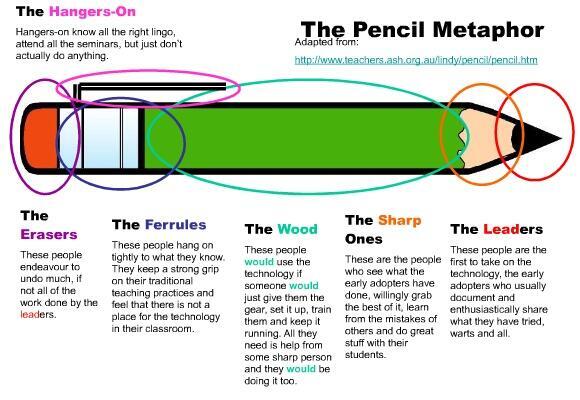
Being a Team Player? The Pencil Analogy.

I found this on Twitter today, and as I love a good visual analogy, I thought I'd share it with anyone willing to read!

This particular image is biased towards the use of technology, but it can be used in many more senses. In this instance, try and think of it as what part of the team you feel you fill...


The model above also shows an excellent distribution method for who would currently fit where in most environments (e.g. there would be more of the 'ferrules' than 'erasers,' and the majority tend to be 'wood') ... but wouldn't it be great if more could move from the 'eraser' to the 'lead?'

I guess, then, the only awkward thing would be trying to draw an effective pencil...

Weeks 14 and 15 - The Background and Beyond of Education

I don't know if I've mentioned this in my other blogs, but time seems to be travelling at an accelerated rate since this course began. It's close to 4 months since the course started and we're nearly at our first 'proper' break.

4 months. One-third of a year. Roughly 120 days. Madness!

These past weeks have seen me teach more, adapt my behaviour management strategies, increase my resources and knowledge of pedagogy, struggle to keep my cool and fairness, and even help those who have broken down into tears for one reason or another. Again, it's difficult to sum up two weeks in a few paragraphs, but this had been the fortnight of being stretched to my limits. Perhaps this is due to numerous observations? Perhaps the pressure of a sudden OFSTED visit caused panic and preparation leading to burning the candle at both ends? Or perhaps it's just that we're now 5 weeks into our placement. We have two weeks to go, the pressure is on to complete tasks and assessments, and the promise of two weeks off is too good to ignore!

Anyway, I wanted to focus briefly on the "background" to education; the often forgotten part of any teachers' life that students, parents, and even teachers ourselves, tend to omit from our responsibilities. There is much more to teaching than just standing in front of a group of eager/awake/unenthused pupils and imparting knowledge, juggling questions, managing behaviour and promoting progress. My mantra for this week, and what could possibly be for the rest of my career, is:

Everyone has obstacles. What gets us through is not by complaining about them or your circumstances, but by figuring out how to get around them using what you have.

Indulge me as I attempt a train of thought here...

A teacher must develop continuously. There is no point to standing still on any aspect, from subject specific information to government - or even worldwide - developments, such as OFSTED and the Pisa Tests. 

Thus, a teacher must be aware of changes and innovations. These may not be given out in a pack or leaflet, and despite the many meetings that occur after the school day is done, sometimes must be sought or distributed otherwise.

Thus, a teacher must share and be willing to cooperate. There is no use to being selfish or one-track-minded when it comes to development. If a resource, a measurement, a tip or a trick comes to mind, there will be far more benefit to distributing the knowledge than keeping it locked up in a safe that only one person can access.

Thus, a teacher must be a team player. It doesn't matter what part of the team you are more suited to, you must be self-sufficient at some times and a mentor, a guide and a rock to your teammates at other times, using a variety of methods, intelligences and positivity to be a reliable teammate.

Thus, a teacher must be innovative. How will an idea grow from a concept to a school-wide non-negociable? How do you bring your school/academy from a "Needs improvement" to an "Outstanding?"

Thus... no matter how much the seemingly endless meetings come around, no matter how many times you have to analyse your class progress, and no matter how many times the goalposts are moved, we as teachers must use the above (whether or not these also comes into the "teaching" aspect of our jobs) to ensure a well-oiled machine of education to benefit the pupils whom we develop and ourselves as educational professionals, from the newest trainee to the highest person in government.

Friday, 22 November 2013

Weeks 12 and 13 - The Black Hole of Time

I decided to combine these two weeks as there's been quite a hefty amount going on, but I wanted to narrow down the events into key areas to avoid typing forever and keep your attention!

I remember one of the first pieces of advice I was given at the start of my course: it doesn't matter how many hours you put in to teaching; it will always demand more. This is true, even for trainees; I find myself working frequently but never quite reaching the end of the to-do pile. It's becoming easier to sort between the 'non-negotiables' and the 'can-put-off-until-next-weeks,' but the key to this is not only good physical organisation, but letting your mind let go of the things that need to be done.

If anything, ITT is training my multi-tasking abilities greatly and forcing me to use to-do lists more effectively (a skill I've always desired but never really been disciplined enough to do off of my own back... that's changed, now!). I even created a shopping list today, which is somewhat of a miracle for anyone who knows me. It seems that the days of walking around Sainsbury's with a trolley and an arm shooting out for anything colourful or sugar-filled are numbered...

I've found my teaching persona taking on more facets, too. My classes are getting used to me, as I am getting used to them. This is great for atmosphere and learning in one respect, as the students respect me, but it's also a nightmare as the students now feel comfortable enough to start pushing boundaries. Perhaps I was too lenient to begin with, but the chatting is starting to get a little out of hand. I find myself starting to raise my voice more often and giving 'the look' more frequently. I hope that this conveys a message of seriousness and boundaries, but not one of dictatorial standards and strictness. I do not want my classroom to have the ethos of a didactic, Victorian lesson, but  I'm worried that I may slip into this if I wish to maintain control. I wonder how else I can keep things under control while keeping things 'light-hearted?'

I'm not sure how teachers are able to work on a full teaching timetable. Of course, I'm sure you get used to the workload, but the fact that I'm on a severely reduced timetable and find myself struggling to get lessons planned and evaluated on time (although this is getting gradually quicker... woo!) makes me wonder how on earth a fully qualified teacher is able to do everything they need to do to be outstanding and still have a life outside of the classroom. Do the pupils realise the amount of work we go through? My naïve view when I was in secondary school was that this was all organised and teachers were reading from a big standardised hymn book... how wrong I was!

There's now less than 1 month left of my first placement. Referring to the title of this post, the time has disappeared faster than I would have ever expected.The key now is to continue developing, reap the fruits of my tutors' knowledge while I still can, and find out where on earth I'm heading for placement B!

(P.S. Bloom's Taxonomy is everywhere and can be used for pretty much anything in a school context. If you're ever in doubt, use Bloom's!)

Saturday, 9 November 2013

Week 11 - Here's the Deep End...

What do you get when you cross a full day conference with 1,000+ colleagues, followed by four days of teaching classes for the first time and around 3 sessions of CPD?

Answer - a trainee who sleeps for the vast majority of his Saturday.

This week has brought many things to the front of my mind. Here's a small selection to make you aware of what it's really like when you're set up against your first week on your first placement:

  • Keep your evenings free of any social life - it will be required to start lesson planning and resource creation and it will take time. I (and all the other trainees) are hoping this will get much quicker with time...
  • Take note of the little tips and tricks of the teachers around you - they will all come in handy even if you don't use them all immediately
  • Don't become a "yes to everything" person - guard your time for where it is needed most (e.g. the first point about lesson planning!)
  • "Start with the end in mind" - whether it's planning lesson outcomes, considering how you'll teach an entire term or even the ethos of a classroom, have the goal in your head and then you can think backwards to how you're going to get there
  • Remember that you're the one in control - I keep forgetting this, and it has shown a few times, but being a teacher means that you're the one at the front with the 30 pairs of eyes looking (mostly) at you and wanting to learn. It's still a strange sensation not to have anyone else coming into the room to start teaching; that's my job now!
  • Kids will surprise you - having had one of the most challenging children in a year group come up to me and apologise for his behaviour, of his own accord, has been the highlight of my week by far. It's one of those many things that I never thought about when becoming a teacher, but seeing someone mature in their behaviour and grow as an individual brings about an overwhelming sense of pride in what I do!
Despite having to create many new things, getting to know names, organise and attend meetings, read up on behaviours and learning theories AND do work for University... I feel as though I'm starting to get my stride up in teaching.

I just hope it isn't a fluke!

Sunday, 27 October 2013

"Thank A Teacher" - Summing up why we do what we do

If I were better with animation software, I would love to attempt to replicate something similar to this video... but why fix it if it isn't broke?

An excellent summary of some of the things that (I hope) every teacher will agree with, and that the public should be able to truly appreciate. Sure, you could be critical and say that it's a little reductionist, but life shouldn't always be about critical analysis.

Enjoy its beauty =]